


 English
  中文简体
中文简体 
 Home / News / Industry News / Pistol Safe Sourcing Guide — Same Price Tag, Completely Different Product
Industry News
Pistol Safe Sourcing Guide — Same Price Tag, Completely Different Product
2026-03-12
Why Two Pistol Safes at the Same Price Can Be Worlds Apart
The Steel Gauge Problem: A Number That Means Less Than It Appears
When a pistol safe listing states "12 gauge steel," most buyers interpret that as a precise material specification. It is not. The gauge system for steel thickness is a historical convention that maps gauge numbers to approximate thickness ranges, and the approximation carries enough tolerance that two products both legitimately described as 12 gauge can have wall thicknesses that differ by as much as 40%. In practical terms, that gap is the difference between a wall that resists a sustained pry attack and one that deforms under moderate force. Neither manufacturer is lying about the gauge designation. They are both working within the tolerance that the gauge system permits — and that tolerance is wide enough to make the specification nearly meaningless as a security benchmark without an accompanying millimeter measurement.
True 12 gauge steel sits at approximately 2.7mm. A product on the lower end of the acceptable range for that gauge designation might come in closer to 2.0mm. A product at the upper end might reach 2.9mm. Those numbers look close on paper, but in a pry resistance test they behave differently. Thinner steel yields sooner, deforms more easily around lock points, and provides less resistance to the leverage a crowbar can generate at a door seam. The buyer comparing two safes on a product listing has no way to distinguish between them from the gauge number alone. The millimeter measurement — which is the only specification that actually describes the physical resistance of the material — is frequently absent from product pages, quote sheets, and even factory specifications.
For buyers sourcing pistol safes at volume, this means the gauge designation on a factory quote is a starting point for a conversation, not a closing specification. The question that needs to follow is: what is the actual measured wall thickness in millimeters, and how is that verified during production quality control? A supplier who cannot answer that question with a specific number and a documented inspection process is a supplier whose delivered product may not match what was quoted.
What the Quote Sheet Says and What Goes Into Production
The divergence between a factory quote sheet and the product that eventually ships is one of the more consistent patterns in sourced consumer goods manufacturing, and pistol safes are not exempt from it. A quote sheet describes what a manufacturer intends to produce, or what they produced on the sample unit that secured the order. It does not automatically describe what comes off the production line six weeks later when cost pressures, material availability, and production scheduling have all had a chance to influence the outcome.
Steel is a commodity with a price that moves. When a manufacturer quoted 2.7mm cold-rolled steel at the time of contract and the steel price rises before production begins, the incentive to substitute a slightly thinner gauge — one that still falls within the quoted gauge designation — is real and not always resisted. The substitution may save a fraction of a dollar per unit. Across a production run of several thousand units, that fraction becomes a number worth acting on. The buyer who specified 12 gauge steel has no grounds to object, because the substitute material still meets the quoted specification. The product that arrives is technically compliant and functionally different from what was expected.
This dynamic is not limited to steel thickness. It appears in foam liner density, in the quality of the locking bolt material, in the grade of the locking mechanism components, and in the composition of secondary structural elements that are not customer-visible during incoming inspection. Each individual substitution may be minor. The cumulative effect of several simultaneous substitutions in a single production run can produce a product that falls meaningfully short of the original sample in ways that only become apparent under stress — or in a return rate report three months after the product has been in customer hands.
| Specification | What the Quote States | What Production May Deliver | Detection Method |
|---|---|---|---|
| Wall thickness | 12 gauge steel | 2.0–2.9mm depending on material batch | Micrometer measurement at incoming inspection |
| Locking bolts | Steel; diameter specified | Diameter met; alloy grade may be downgraded | Material certification request; hardness test |
| Hinge material | Metal construction | Zinc alloy die-cast substituted for steel | Visual inspection; magnet test; destructive sample test |
| Interior liner | Foam padding included | Thinner or lower-density foam used | Compression test; thickness measurement |
The Hinge Detail That Undermines Everything Else
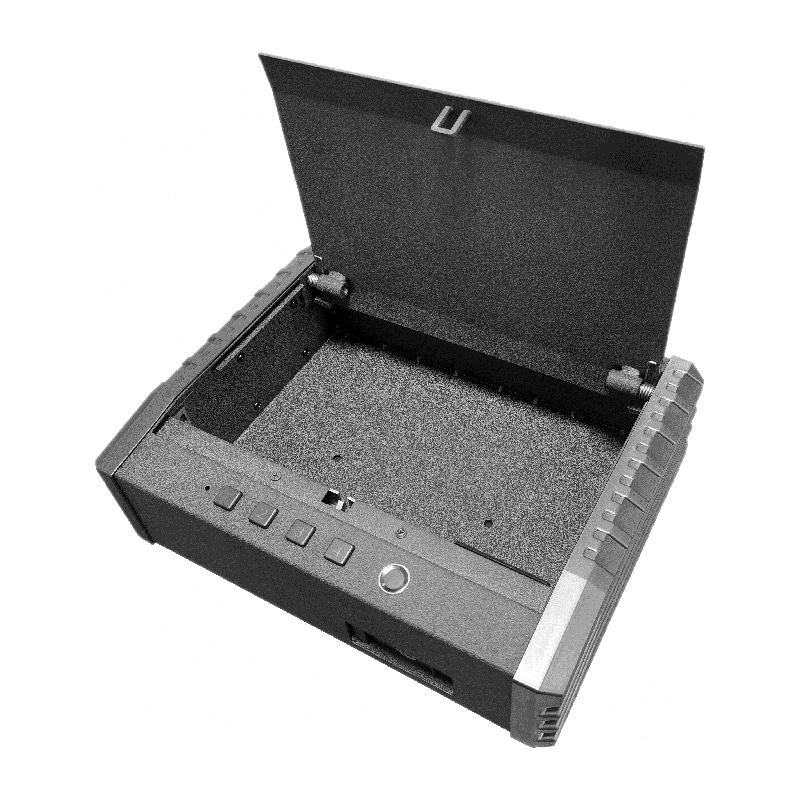
Of all the places where a pistol safe can fail to deliver the security it implies, the hinge assembly is the one most likely to be overlooked during evaluation and most likely to be exploited during an actual breach attempt. A safe with a thick steel door panel, a multi-point locking mechanism, and a solid steel body can still be opened in under three minutes if its hinges are made from zinc alloy die-cast material rather than hardened steel. Zinc alloy die-cast is a common manufacturing material for components that need to be shaped with precision and produced at low cost. It is not a material that resists sustained mechanical force. Under the leverage that a standard pry bar can generate at an exposed hinge point, zinc alloy die-cast hinges fracture rather than deform — and once the hinge fails, the door opens regardless of how many locking bolts are engaged on the opposite side.
This vulnerability is particularly consequential because it is not visible in a standard product review. A reviewer who evaluates a pistol safe by examining its door thickness, testing its keypad, and assessing its overall fit and finish will not identify a zinc alloy hinge as a weakness unless they specifically test it under mechanical stress. Most consumer reviews do not. The hinge material rarely appears in product specifications, and when it does, it is described in terms — "metal construction," "reinforced hinge," "heavy-duty hardware" — that do not distinguish between steel and zinc alloy. The buyer reading those descriptions has no reliable way to determine what they are actually purchasing without requesting a material specification from the manufacturer or conducting a physical test on a sample unit.
The practical implication for buyers sourcing at volume is that hinge material should be an explicit line item in product specifications, not an assumed attribute. The question to ask is not whether the hinges are metal — almost all of them are — but what specific alloy they are made from, what the yield strength of that alloy is, and whether the hinge design is internally mounted or externally exposed. An internally mounted hinge, regardless of material, presents a more constrained attack surface than an exposed external hinge. A hardened steel hinge, regardless of mounting position, resists mechanical force more effectively than a die-cast alternative. Both attributes matter, and neither should be left to assumption.
Unit Cost Versus the True Cost of a Weak Product
The cost comparison that happens at the point of sourcing — unit price against unit price, with the lower number winning — captures only one dimension of what a product actually costs to bring to market and keep there. The dimensions that do not appear on the quote sheet are frequently the ones that determine whether a sourcing decision was sound or not, and in the pistol safe category, those hidden costs are directly connected to the material and construction compromises described above.
Return rates are the most immediate and most quantifiable of these hidden costs. A pistol safe that fails in the field — a hinge that fractures, a door that warps, a locking mechanism that jams — generates a return that costs the retailer or brand the product price, the reverse logistics expense, and the customer service interaction that accompanies it. In categories where the failure mode is a security concern rather than a cosmetic defect, the return is often accompanied by a strongly negative review. A one-star review that describes a security product as failing to provide security is not a piece of feedback that stays contained — it affects conversion rates on the listing, raises questions in the minds of prospective buyers, and in sufficient volume, can suppress sales across an entire product line.
The unit cost gap between a well-constructed pistol safe and a cost-reduced alternative is typically measured in dollars, sometimes in fractions of a dollar per unit. The cost of the return rate differential, the review score differential, and the brand equity differential is measured in multiples of that gap across the lifetime of the product in the market. Buyers who evaluate sourcing decisions purely on unit cost are making a calculation that excludes most of the variables that determine whether the decision was profitable. The quote sheet shows the cost of acquiring the product. It does not show the cost of selling it, supporting it, or replacing it when it fails.
| Cost Category | Visible at Sourcing | When It Appears | Relative Magnitude |
|---|---|---|---|
| Unit purchase price | Yes | At order placement | Baseline reference |
| Inbound freight and duties | Partially | At shipment | Moderate; calculable |
| Return processing cost | No | 3–6 months post-launch | High if return rate exceeds 3–5% |
| Review score impact on conversion | No | Accumulates over product lifetime | High; difficult to reverse once established |
| Brand reputation cost | No | Long-term; affects adjacent SKUs | Potentially the largest of all categories |
What a Meaningful Product Specification Actually Looks Like
The gap between a weak pistol safe and a more reliable one at the same price point is not inevitable — it is a product of underspecified purchasing requirements and insufficient production verification. Buyers who want to close that gap need to replace gauge designations with millimeter measurements, replace general material descriptions with alloy specifications, and replace factory assurances with documented inspection results. This is not an unusual standard to hold a supplier to. It is the standard that any buyer serious about product quality should apply as a baseline, and most credible manufacturers can meet it without difficulty.
A meaningful product specification for a pistol safe at minimum addresses wall thickness in millimeters with an acceptable tolerance range, door panel thickness separately from body panel thickness, hinge material by alloy designation and whether the design is internally or externally mounted, locking bolt diameter and material grade, and the certifications — if any — that the product carries from recognized testing organizations. Specifications that include these elements give the buyer a basis for incoming inspection that goes beyond visual assessment. They also give the supplier a clear signal of what will be verified, which in itself changes the production incentive structure. Suppliers who know that wall thickness will be measured with a micrometer at receiving have less room to make material substitutions than suppliers who know the inspection will consist of a visual check and a functional test of the keypad.
The difference between a pistol safe that holds up under customer use and one that generates returns and negative reviews is not always large in manufacturing terms. It is often a matter of a fraction of a millimeter of steel, a hinge alloy upgrade, and a production verification process that confirms what was specified is what was built. None of these changes require a fundamentally different product. They require a buyer who knows which specifications matter, asks for them explicitly, and verifies them before the shipment leaves the factory.
Same Quality, Lower Price — Here's Why That's Actually Possible
Price Is a Product of Cost Structure, Not Just Margins
When two manufacturers quote different prices for what appears to be the same product, the instinctive interpretation is that the cheaper one has cut something — thinner material, weaker components, faster assembly with less inspection. That interpretation is sometimes correct. But it is not the only explanation, and in many cases it is not the right one. Price differences between manufacturers frequently reflect structural differences in cost rather than differences in what goes into the product. A manufacturer with a lower cost base can price competitively while maintaining the same material specifications and production standards as a higher-priced competitor. Understanding where that cost base difference comes from is the key to distinguishing a genuinely competitive price from one that is competitive because something invisible has been removed.
Cost structure in manufacturing is shaped by a range of factors that have nothing to do with cutting corners: proximity to raw material sources, ownership of production tooling, the efficiency of the production process, the volume commitments that allow better input pricing, and the degree to which production steps are integrated rather than outsourced. Each of these factors can produce meaningful cost differences between two manufacturers building to the same specification. The manufacturer with the structural cost advantage does not need to reduce quality to offer a lower price — their cost base simply starts from a lower point.
Where You Sit in the Supply Chain Determines What You Pay for Steel
Steel is the primary material cost in most metal enclosure and hardware products, and the price a manufacturer pays for it varies considerably depending on their position in the supply chain. A factory located close to a steel mill, purchasing directly in large-volume contracts, pays a materially different price than a factory that sources through a regional distributor or trading company. The difference is not marginal — direct procurement from primary suppliers at volume can reduce steel input costs by 8 to 15 percent compared to purchasing through intermediaries. On a product where steel accounts for 30 to 50 percent of the bill of materials, that input cost difference translates directly into a lower cost of goods without any change to the specification.
This supply chain position advantage is structural rather than opportunistic. It reflects decisions about where to locate production, how to build supplier relationships, and what volume commitments to make — decisions that take years to establish and that cannot be replicated quickly by a competitor who has not made the same investments. A manufacturer who has built direct material sourcing relationships over a decade of production at scale is not offering a lower price by accepting a lower margin. They are offering a lower price because their input costs are genuinely lower, and that difference is sustainable rather than a temporary pricing tactic.
| Procurement Position | Typical Steel Cost Differential | Source of Difference | Sustainability |
|---|---|---|---|
| Direct mill procurement at volume | Baseline — lowest input cost | No intermediary margin; volume pricing | High; built on long-term contracts |
| Regional distributor purchasing | +5–8% above baseline | Distributor margin added to mill price | Moderate; subject to distributor pricing changes |
| Trading company purchasing | +8–15% above baseline | Multiple intermediary layers; smaller volume tranches | Lower; pricing volatile with market conditions |
Proprietary Tooling Versus Shared Public Molds: The Cost That Shows Up Later
Tooling decisions at the design stage have long-term consequences for both unit cost and product quality that are not visible in the initial price comparison. Public molds — standardized tooling shared across multiple customers and product lines — offer a lower upfront cost because the tooling investment is amortized across many users. For buyers focused on minimizing initial capital outlay, this looks attractive. The complications emerge over time and at scale, in ways that a unit price comparison does not capture.
Products built on public molds have limited customization tolerance. The dimensions, wall thicknesses, and structural features of a public mold are fixed and shared, which means a manufacturer cannot modify them to improve fit, tighten tolerances, or address a quality issue without moving to proprietary tooling. When a design flaw surfaces in production — a seam that does not close cleanly, a dimension that affects assembly tolerance — the manufacturer using public tooling has no path to a tooling-level fix. The result is a higher rate of dimensional variation, which translates into higher assembly rejection rates, more manual adjustment in the production process, and ultimately a higher rate of field failures and customer returns.
Proprietary tooling requires a higher upfront investment, but it gives the manufacturer control over the geometry and tolerances of every component produced from that tool. Adjustments can be made. Tolerances can be tightened. Design improvements can be incorporated without changing suppliers or negotiating access to a shared asset. Over a production run of meaningful volume, the per-unit cost of proprietary tooling amortizes to a small fraction of the unit price, while the quality and consistency advantages persist at full value across every unit produced. The total cost of a public mold product, when return rates and customer service costs are included, is frequently higher than the total cost of a proprietary tooling product — even when the public mold product has a lower quoted unit price.
Integrated Manufacturing: What It Means in Practice
The term "integrated manufacturing" appears in many factory descriptions, but its practical meaning varies considerably. In its most substantive form, it means that the steps required to produce a finished product — cutting, forming, welding, surface treatment, assembly, and quality inspection — all occur within a single production environment under unified quality control, rather than being distributed across multiple subcontractors. The difference between these two production models is significant in terms of both cost and quality consistency.
When production steps are outsourced across multiple suppliers, each handoff introduces a potential point of specification drift, scheduling delay, and quality variation. A surface treatment subcontractor who applies phosphating and painting on a batch basis may process parts from multiple customers simultaneously, with variation in chemistry and process time that affects coating adhesion and corrosion resistance. An assembly subcontractor working from a supplied component kit may encounter dimensional inconsistencies between parts produced at different facilities and resolve them through manual adjustment that introduces its own variation. Each of these handoffs adds cost — in logistics, in inspection, in rework — and each adds a point where the specification can diverge from what was intended.
A facility equipped with laser cutting, CNC machining and bending, laser welding, injection molding, phosphating, painting, and final assembly under one roof eliminates these handoffs. The same quality control system governs every step. Material traceability runs from raw steel through finished product without interruption. When a process parameter drifts — coating thickness, weld penetration, dimensional tolerance — it is detected and corrected within the facility rather than discovered after delivery. The per-unit cost of this integration is lower than the cumulative cost of managing a multi-supplier production chain, and the quality consistency it produces is higher. Over a production run at scale, both advantages compound.
| Production Model | Quality Control Scope | Cost Structure | Risk Profile |
|---|---|---|---|
| Integrated single-facility production | Unified; covers all process steps | Lower logistics and coordination cost; higher fixed asset base | Lower; issues detected and resolved internally |
| Multi-supplier subcontract model | Fragmented; each supplier controls their own step | Lower upfront capital; higher coordination and inspection cost | Higher; specification drift at each handoff point |
What OEM Experience With Global Brands Actually Demonstrates
A manufacturer's OEM history is one of the more informative data points available when evaluating production capability, because it reflects what external customers with their own quality systems have verified rather than what the manufacturer claims about itself. OEM relationships with companies like Siemens, Emerson, Schneider, Panasonic, and Sanyo are not established through a catalog submission and a competitive quote. They are established through an audit process that evaluates production facilities, quality management systems, process controls, material traceability, and the manufacturer's ability to hold tolerances consistently across production runs. A manufacturer who has passed these audits and maintained these relationships over time has been evaluated by quality engineers whose standards are set by global market requirements, not by minimum acceptable thresholds.
The practical value of this OEM track record for a buyer sourcing at any volume is that it provides an independent reference for production capability that does not rely on the manufacturer's own marketing materials. The process disciplines required to produce components for an industrial automation company like Siemens or an HVAC controls company like Emerson — dimensional accuracy, material certification, process documentation, production consistency — are directly transferable to the production of any product built to a defined specification. A facility that has demonstrated these capabilities in a demanding OEM context is not a facility that needs to compromise on material or process to offer a competitive price. Its competitive pricing comes from the efficiency of its production infrastructure, not from reductions in what goes into the product.
The Real Arithmetic of Competitive Pricing
The arithmetic of how a well-positioned manufacturer can offer a lower price without reducing quality becomes straightforward. Direct steel procurement at volume saves 8 to 15 percent on the primary material cost. Proprietary tooling eliminates the downstream costs of dimensional variation and field failures. Integrated production eliminates the logistics, coordination, and rework costs associated with a multi-supplier model. A production facility equipped with 70-plus machines across more than 50,000 square meters of floor space generates the throughput volume that keeps fixed cost per unit low. OEM-grade process discipline reduces internal scrap and rework rates to levels that a less structured production environment cannot match.
None of these advantages require accepting lower quality. Each of them is a genuine structural cost reduction that allows the manufacturer to offer a lower price while building to the same or higher specification than a competitor whose cost base is less efficiently structured. The buyer who understands this can evaluate a competitive price not with suspicion but with the right questions: Where does the steel come from and at what volume? Is the tooling proprietary or shared? What is the degree of vertical integration in the production process? What OEM customers have audited and approved the facility? These questions have answers that either support the price or explain why it should be higher. A manufacturer with a genuine structural cost advantage can answer all of them clearly.
Which Pistol Safe Buyers End Up Losing the Most by "Saving Money"?
The Buyer Who Compares FOB Price Without Requesting Mill Certificates
The most common version of this mistake happens before the purchase order is even written. A buyer receives quotes from three or four suppliers, ranks them by FOB price, and selects the lowest without requesting material documentation. The product description on each quote says "12 gauge cold-rolled steel." The buyer assumes this means the same thing across all four suppliers. It does not. As discussed elsewhere, the gauge designation covers a range of actual thicknesses wide enough that two products both described as 12 gauge can differ by 40 percent in real wall thickness. The only document that closes this ambiguity is a steel mill certificate — a third-party record issued by the steel producer that states the actual measured thickness, the chemical composition of the alloy, and the mechanical properties of the material supplied.
A mill certificate cannot be fabricated by a manufacturer to match a specification they did not actually purchase. It is issued by the mill and references the specific coil or sheet batch from which the material was cut. A supplier who provides a genuine mill certificate alongside their quote is demonstrating that the steel they described is the steel they actually bought. A supplier who deflects the request, provides an internal quality document instead, or claims the certificate is available upon request after order placement is communicating something about their material sourcing that the buyer should take seriously before committing to a purchase order.
The loss this buyer experiences is typically not visible at receiving. The product arrives, passes a visual inspection, and enters inventory. It becomes visible three to six months later, when return rates begin to accumulate from customers whose safes have deformed under pry attempts, whose door seams have separated under normal handling stress, or whose locking mechanisms have become misaligned because the thinner steel body has flexed enough to affect the bolt geometry. By that point, the buyer has paid for the inventory, paid for inbound freight, paid for warehouse handling, and is now paying for reverse logistics and replacement units. The FOB price saving from Order 1 has been consumed several times over by the downstream costs of the product it purchased.
The Buyer Who Accepts "Certification in Process" and Places the Order Anyway
California is the largest firearms accessories market in the United States and one of the most regulated. The California Department of Justice maintains an approved roster of firearms safety devices, and a pistol safe that is not on that roster cannot be legally sold in California as a compliant storage solution for handguns. Getting onto that roster requires submitting the product for DOJ review, a process that involves testing, documentation review, and administrative processing. The average time from submission to approval runs between eight and fourteen months. This is not an estimate or a worst-case scenario — it is the documented typical cycle for the review process.
A buyer who is sourcing a pistol safe for distribution into California and asks a supplier about DOJ certification will sometimes receive the response that certification is "in process" or "pending approval." This answer is technically accurate and practically useless as a basis for placing an order. "In process" means the product has been submitted but not approved. It does not mean approval is imminent. It does not mean the product will pass. And given the eight-to-fourteen-month review cycle, it does not mean the buyer will have a certifiable product available for sale within any planning horizon that a retail buyer or distributor can reasonably work with.
The buyers who accept this answer and place the order anyway are typically under schedule pressure — a buyer who needs product in Q3 and wants to secure factory capacity — or are assuming the certification will come through before the goods arrive. Both assumptions carry real risk. If the California DOJ review is not complete by the time the product is ready to ship, the buyer is holding inventory that cannot be sold into their primary market. If the product ultimately does not receive approval — which happens — the buyer is holding inventory that can never be sold into California at all. The cost of this outcome is not a line item on the original quote. It is the full landed cost of the purchase order, sitting in a warehouse with no qualified buyer.
| Certification Status | What It Means | Safe to Order For California Distribution? |
|---|---|---|
| California DOJ Approved — on roster | Product has passed review and is listed as compliant | Yes |
| Certification in process — submitted | Application filed; review ongoing; 8–14 month typical cycle | No — approval timeline is not guaranteed |
| Certification planned — not yet submitted | No active review; timeline is entirely speculative | No |
| No certification — not submitted | Product has not entered the DOJ review process | No — product cannot be sold as compliant in California |
The Buyer Who Tests the Door Panel but Ignores the Hinge
Sample evaluation is a standard part of responsible sourcing, and most experienced buyers know to apply some form of physical stress test to a pistol safe sample before approving production. The tests that tend to get performed are the ones that are most intuitive: push on the door panel to assess flex, try to pry at the door seam, test the locking mechanism through repeated cycles, check the keypad response. These tests are worthwhile. They are also incomplete, because they focus on the components that are most visible and most discussed in product specifications while leaving the hinge assembly — which is often the actual weak point — untested.
A zinc alloy die-cast hinge does not fail under the pressure of a hand push or a light pry attempt at the door seam. It holds up through the kind of handling that occurs in a sample evaluation. It fails under the sustained leverage of a pry bar applied at the hinge point itself — a tool and a technique that an opportunistic thief will use and that a standard sample evaluation does not replicate. The buyer who approves a sample based on door panel stiffness and locking mechanism function has tested the product against the wrong attack vector. The hinge failure mode requires a different test: direct mechanical stress applied to the hinge assembly, or a material verification request that confirms the hinge is steel rather than zinc alloy die-cast.
The practical consequence of this oversight is a product that passes incoming inspection, performs adequately in functional testing, and fails in the field under conditions that a more thorough evaluation would have identified. The returns that result from hinge failures are particularly damaging from a review perspective, because a customer whose safe was opened by a thief is not a customer who writes a moderate negative review. They write a review that describes a security product as having failed at its only job, and that review has an outsized effect on conversion rates for every subsequent buyer who reads it. The cost of approving a zinc alloy hinge in a sample evaluation is not the cost of the returned unit. It is the cost of the review score damage that follows it into the market.
The Pattern Underneath All Three Mistakes
Each of these three buyer profiles made a decision that saved money on a specific line item: the FOB unit price, the time cost of waiting for certification, the effort cost of a more thorough sample evaluation. Each of those savings was real at the moment the decision was made. And in each case, the saving on Order 1 produced a cost on Order 2 — except that Order 2 never came, because the customer who bought Order 1 did not come back.
This is the pattern that connects all three mistakes. The pistol safe category, like most consumer hardware categories, runs on repeat purchase and referral. A retailer or distributor who finds a supplier that delivers consistent quality, ships product that carries its certifications, and generates low return rates has found something worth protecting. They place Order 2, Order 3, and Order 4. They refer the supplier to other buyers in their network. The relationship compounds over time into a volume and margin profile that a single optimized purchase order cannot replicate.
The buyer who optimized the FOB price on Order 1 and received product that generated returns has a different outcome. They have absorbed the return costs, managed the customer complaints, and taken the review score damage. They are now sourcing again for a replacement product, starting the evaluation process from scratch, and carrying the operational cost of the transition. The saving on Order 1 was not a saving. It was a deferred cost that arrived with interest attached.
| Buyer Mistake | Apparent Saving | Actual Cost | When the Cost Appears |
|---|---|---|---|
| FOB price only; no mill certificate | Lower unit cost at order placement | Returns, replacements, review damage from thin-wall failures | 3–6 months post-launch |
| Accepted "certification in process" | Secured factory capacity on preferred timeline | Inventory that cannot be sold into California market | At shipment or during DOJ review period |
| Tested door panel; ignored hinge | Faster sample approval; lower evaluation cost | Field failures; one-star reviews; conversion rate suppression | 6–12 months post-launch; accumulates over product lifetime |
What the Buyer Who Does Not Lose Money Does Differently
The buyers who avoid these outcomes are not necessarily more experienced or better resourced than the ones who fall into them. They are more deliberate about which shortcuts carry hidden costs and which are genuinely low-risk. They request mill certificates as a standard part of the quoting process, not as an exceptional request. They treat "certification in process" as a disqualifying answer for any product destined for a market where that certification is legally required. They include hinge material as an explicit line item in their sample evaluation checklist, because they understand that the hinge is a structural component, not a cosmetic one.
These practices add a small amount of friction to the sourcing process. They require asking for documentation that some suppliers will not have, which identifies those suppliers early rather than after a purchase order has been placed. They require a sample evaluation protocol that takes somewhat longer than a quick functional check. They require holding a firm line on certification status rather than accepting a provisional answer under schedule pressure. None of these requirements are unreasonable, and none of them prevent a buyer from finding a competitive price. What they prevent is the specific pattern of saving money on Order 1 and absorbing the cost of that saving on every order that follows — or does not follow — because the product that was purchased did not perform the way a pistol safe is supposed to perform.
References / Sources
California Department of Justice — "Firearms Safety Device Certification Program and Approved Roster"
California Department of Justice — "Handgun Safety Certificate and Storage Requirements"
American National Standards Institute — "ANSI/BHMA A156.30: High Security Locks and Safes"
Underwriters Laboratories — "UL 1037: Standard for Antitheft Alarms and Devices"
Steel Technologies — "Cold Rolled Steel Sheet Gauge Thickness Tolerance Reference"
American Iron and Steel Institute — "Steel Products Manual: Sheet Steel Gauge and Thickness Standards"
National Institute of Justice — "NIJ Standards for Residential Security Containers"
Consumer Product Safety Commission — "Product Return Rate Benchmarks in Consumer Hardware Categories"
National Shooting Sports Foundation — "Firearms Storage and Safety Device Market Report"
Grand View Research — "Gun Safe and Vault Market Size, Share and Trends Analysis"
Mordor Intelligence — "Home Security Products Market — Global Industry Analysis and Forecast"
ASM International — "Zinc Alloy Die Casting: Material Properties and Mechanical Performance Data"
-

Arnostanley Electric is committed to providing customers with home security OEM and ODM services, as well as comprehensive professional solutions.
-
Product List
Pistol Safe Lock Box Gun Cabinet Home Safe Safe Accessories Product Customization -
Contact Info.
+86-(0)574-6248 327+86-180 6720 2630Lucas_zhu@arnostanley.comNo.16 Beixing East Road, Yuyao City, Zhejiang Province, China -
Follow Us
Copyright © 2025 Ningbo Arnostanley Electric Co., Ltd. ALL Rights Reserved.
Custom Secure Storage Solutions Suppliers
